Contact Us:



Portland, OR – June 11, 2026.
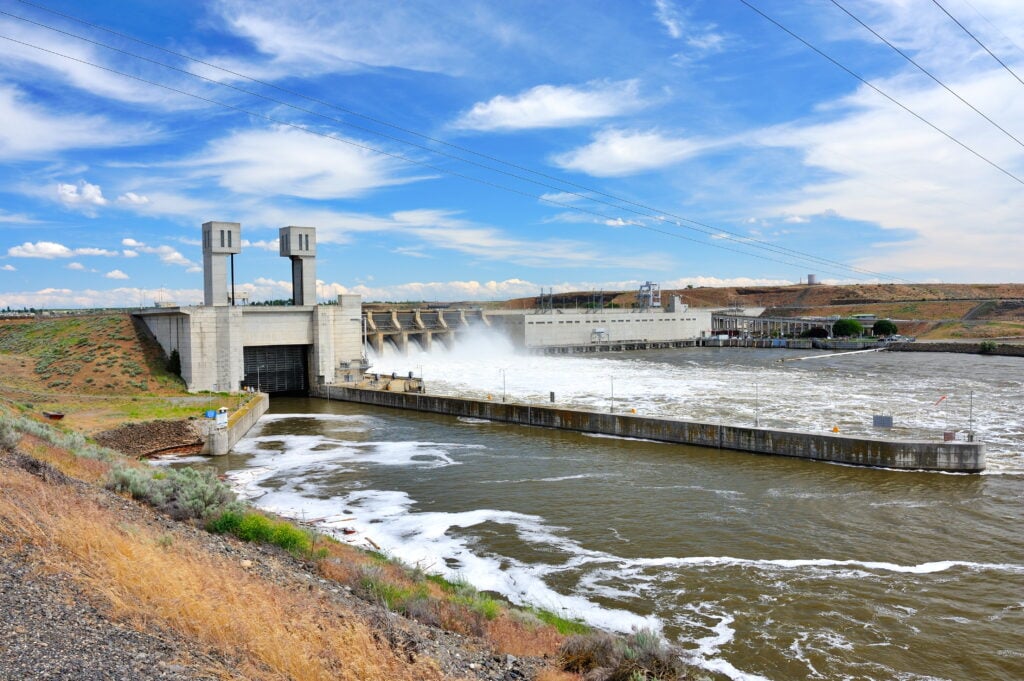
The Public Power Council (PPC) is expressing concerns over new, court-ordered Columbia River operations at John Day Dam following reports that adult salmon passage there has been significantly delayed during the current migration season. The John Day Dam concern comes just after PPC joined a stipulation filed in late May by Federal Defendants in the ongoing Columbia River System Operations (CRSO) litigation to protect spawning salmon migrating up the Columbia River after adult passage was being slowed by new river operations at Lower Monumental Dam on the Snake River.
Across the Columbia and Snake rivers, new operations were adopted as part of the Oregon District Court’s recent Preliminary Injunction Order, which granted Plaintiff’s requests to implement untested levels of spill at the region’s federal hydro projects. The court’s order focuses primarily on altering river operations with highest-ever levels of “spill” over the region’s dams (instead of through hydropower turbines). PPC notes, as the leading Intervenor-Defendant for public power, that these new operations came at great cost to Northwest ratepayers in the hopes of achieving benefits to salmon, which were speculative at best and are now producing unintended consequences.
The stipulation filed in late May allows the Federal Defendants to modify operations as needed to address fish passage issues at specific lower Snake River and lower Columbia River dams. The stipulation was required in response to observed delays in returning adult fish, delays that Plaintiffs allowed to reach near critical levels before agreeing to allow modified operations to facilitate adult migration.
“The untested and experimental spill regime put in place by this Preliminary Injunction appears to have immediate negative consequences for adult salmon returns while imposing unnecessary costs – two adult fish delay events in a matter of days is completely unacceptable,” said Scott Simms, CEO & Executive Director of PPC. “Federal fish managers know how to operate these dams for the safety and well-being of salmon, yet are being forced to run these rivers recklessly.”
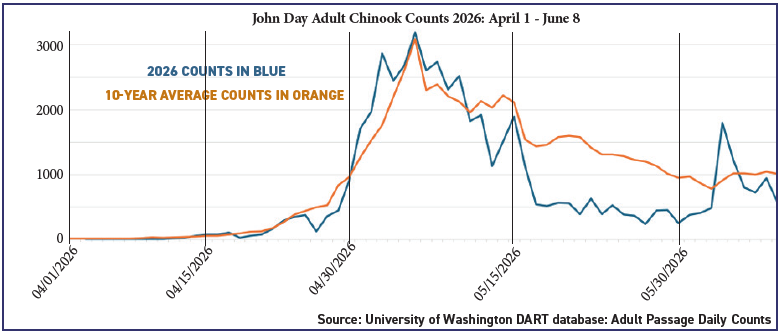
This year’s spill season has been in effect for roughly two months. Court ordered spill at John Day is higher and more continuous than has ever been applied at the project. After about two months of continuous spill up to the prescribed 125% total dissolved gas (TDG) levels at John Day Dam under the new operations, adult Chinook passage precipitously declined from an average of 2,222 to 483 daily counts from the first to second half of May and early June. The U.S. Army Corps of Engineers then took emergency action, reducing spill to 40% of project outflow in response to these dramatic salmon migration declines for three days starting June 3. Promptly in response to reduced spill, adult Chinook returns increased to 1,275 average daily counts over a three-day period.
“These dramatic swings in adult Chinook counts appear highly correlated to spill levels, and support long-standing studies showing tailrace turbidity can confuse, and challenge the upriver adult migration,” Simms said.
These new reported delays, combined with those flagged earlier at Lower Monumental Dam, raise questions about unintended consequences of the spill regime currently being imposed across the Columbia River System—particularly the unprecedented spill levels at John Day Dam. The court-ordered operations were implemented despite repeated warnings from the federal Action Agencies, PPC and other regional stakeholders that the measures were largely untested at the scale now being required. PPC has consistently argued that expanded spill mandates should be grounded in demonstrated biological benefits and rigorous scientific evaluation, not assumptions.
“For years, proponents of increased spill have argued that more spill would produce better outcomes for fish. If the facts confirm that adult salmon are now experiencing multiple days of migration delay under this new, untested operations regime, the region deserves immediate answers,” Simms said.
The current spill requirements were imposed as part of a federal court injunction affecting operations at eight Columbia and Snake River dams. PPC subsequently joined federal defendants in seeking appellate review of the injunction.
“Northwest families and businesses are already paying substantial costs associated with these court-ordered operations,” Simms said. “With these operations now appearing to create new obstacles for migrating adult salmon, it underscores the danger of imposing sweeping changes before they have been adequately tested and validated.”
PPC urges Plaintiffs to recommit to collaborative, science-driven solutions for salmon recovery rather than relying on litigation-driven operational experiments.
“The Northwest needs solutions that actually work for fish,” Simms said. “We cannot afford policies that increase costs, reduce system reliability, and ultimately fail to deliver the biological outcomes they promise.”
PPC will continue monitoring the situation and will provide additional information as federal agencies complete their review.
The Public Power Council, established in 1966, is a nonprofit association representing the interests of more than 100 consumer-owned electric utilities in Washington, Oregon, Idaho, Montana, Wyoming, and Nevada which collectively serve millions of electricity consumers. PPC’s mission is to preserve and protect the benefits of the Federal Columbia River Power System for consumer-owned utilities, and is a forum to identify, discuss and build consensus around energy and utility issues. For more information, please visit us at www.ppcpdx.org.