Contact Us:



The rate philosophy at your cooperative is based on the idea of fairness; the cost causer is the cost payer. A substantial portion of Columbia Rural Electric Association’s (REA’s) power bill from the Bonneville Power Association (BPA) is based on system demand. Members with high usage place more demand on our distribution system and therefore increase our costs.
Members with high usage place more demand on our distribution system and therefore increase our costs. A member whose peak demand is low should not have to subsidize a member whose peak demand is high.
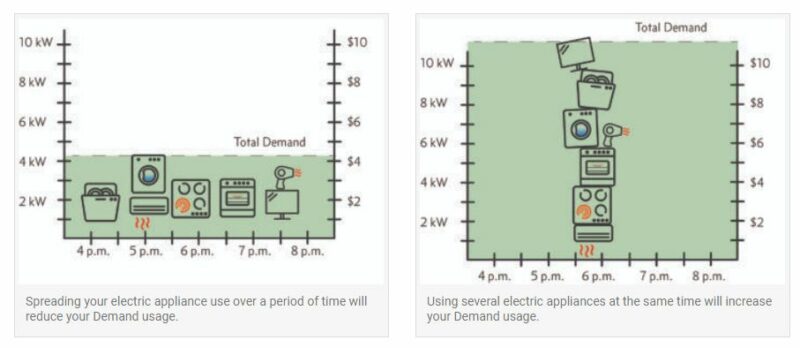
The demand charge refers to how much energy you need, or the specific demand at any one time, measured over any 15 minute period. For example, if you turn on your heat pump, oven, stove and clothes drier at the same time, the demand will be very high compared to the average you need over a full day. To help keep the demand charge lower, it’s helpful to turn on high-usage systems individually as opposed to simultaneously.
Demand, measured in kilowatts (kW), is the speed at which a member uses a certain amount of electricity. An example of lower demand would be running your oven at 6 p.m. and your clothes dryer afterwards at 9 p.m. This places less demand on the system than running both appliances at the same time.
The more high-energy appliances the customer uses at the same time within a 15 minute period, the higher the demand.
Beginning January 1, 2024, the residential demand charge will apply to members who exceed 7 kW in any given month. The demand is reset each month. The residential demand charge is structured as follows.
There are easy ways for most members to reduce their kW demand on the system and we are happy to help work with you.
If you would like to see your usage history, it is available through SmartHub, both online and in the SmartHub app.
Call (509) 526-4041 or email Member Services if you have questions.