Contact Us:



Story and photo by Rural Montana Editor Ryan Hall
Protecting adult salmon has been a consideration at the lower Snake River dams since they were built, with a fish ladder included in the construction of each 1. Later, juvenile fish protection and mitigation factors were added, helping ensure young and adult salmon can complete their migration and spawning routes.
Not only do thousands of fish use the ladders daily during peak runs, but juvenile fish are bypassed around dams and spillage and turbine use are optimized to protect young and adult fish. Researchers study thousands of fish each season at the dams.
“We don’t make a decision without considering fish,” said Brian Vorheis, operations project manager for Ice Harbor Lock and Dam.
Lower Granite Lock and Dam is the first dam juvenile fish encounter on the lower Snake River and the last for adult fish. Rob Lustig, the dam’s operations project manager, said upward of a dozen research projects take place there during fish runs.
The National Oceanic and Atmospheric Administration, Idaho Fish and Game, the Nez Perce Tribe, United States Geological Survey and many other agencies send researchers to the facilities at the dam. They measure, weigh and tag adult and juvenile fish to better understand the dams’ impacts on their numbers and how mitigation measures work.
“It is key for research and management,” said Elizabeth Holdren, Lower Granite Lock and Dam supervisory fish biologist.
The dams were built with adult fish migration in mind, primarily steelhead trout and 3 salmon species: chinook, sockeye, and coho. A focus on juveniles was added later, with dam modifications and new programs aimed at aiding their survival.
Paul Ocker, chief of operations and maintenance for the Walla Walla District of the U.S. Army Corps of Engineers, said the emphasis has shifted to juvenile fish, especially considering recent NOAA biological opinions and the recent court settlement reached by the White House with 2 states and 4 tribes.
That settlement, along with biological opinions calling for increased spill— diverting water away from the powerhouse and either through or over the dam— has resulted in operational changes. The changes from the settlement began with the spring salmon run.
Ocker said the court decisions and environmental groups want all fish to pass the dams without going through the powerhouse.
The powerhouse route has a survival rate of about 90%, with less than 10% of all fish using that route to pass the dams on the lower Snake River. Newer turbines, installed at Ice Harbor Dam, show survival rates of 96% to 98%.
Juvenile fish can avoid the powerhouse in several ways, such as being diverted by fish screens to a bypass channel. Most diverted fish are barged downriver to avoid any other dam downstream.
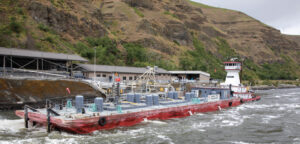
The Army Corps of Engineers barges millions of fish each year, beginning at Lower Granite Dam and dropping off the fish below Bonneville Dam. Throughout the journey, fresh water from the river is pumped through the holding tank so fish can still olfactory imprint to the river to find their way back as adults, Holdren said. The survival rate for barged fish is about 98%—the highest of all the routes.
Other methods of avoiding the powerhouse include going through a traditional spillway or a removable spillway weir.
2 main elements of the recent settlement agreement are that spillage is prioritized over power production during the salmon runs, and the maximum spillage is based on the total dissolved gas generated in the river because of the dams.
The first element is straightforward. The dams will run 1 turbine at minimum generation, typically requiring about 10,000 cubic feet per second of water, then spill the rest until they hit the minimum cap in the agreement. At that point, any remaining water can be used to create additional power.
Running water through the powerhouse does not increase the natural total dissolved gas in the river, but spilling does. The water becomes supersaturated due to pressure changes and other factors involved with a massive amount of water dropping a significant distance. Too much gas can cause gas bubble disease—like the bends in human divers—and is often fatal.
Ocker and the other Army Corps biologists have an opinion on what is safe for fish, “but as the Corps of Engineers, we are required to balance what the people need and what the environment needs,” he said.
The device that measures the TDG is between 7/10 of a mile from the dam at Lower Granite and 3.6 miles downstream from Ice Harbor Dam. On-site biologists and operations officials at the 2 dams said they could not speculate what the TDG was at the point the spilled water hits the river, but said it is reasonable to expect it to be higher than it would be at the point it is measured.
Another concern with fish using spillways is the pressure change it introduces. Most salmon prefer to be in the top 20 feet of the water column, but the traditional spillway gates are 53 to 57 feet below the surface. This forces fish to swim to those depths, at pressures of up to 25 pounds per square inch. Once they swim through the gate, they exit the dam down the spillway and to the river below.
“They go from 25 PSI to atmospheric pressure instantly,” Lustig said.
That can have negative impacts on the fish, he said. Those fish can become disoriented and rise to the top of the water column, increasing the likelihood of predation by other fish or birds. Predatory birds, except for endangered raptors, are hazed from the immediate area of the dams by water cannons, gunshot sounds played over speakers, and wires stretched across the river.
Fish that pass through the removable spillway weir do not experience much pressure change, but that gate is much more expensive and incapable of allowing higher flows of water through the dam in its normal configuration. The weir is designed to be removed during high-flow flood events.
New operational changes also impact adult fish returning upriver to spawn. According to Holdren, while the fish ladders have proven effective, the increased spillage and resulting current changes have slowed migration.
Holdren and Ocker said increased spills have caused eddies and disrupted the attraction flow designed to draw fish to the ladders. Each dam has a specific turbine start order so the entrance to the fish ladder features a similar flow to a naturally flowing river and attracts fish to it, regardless of the number of turbines producing power.
“We need attraction for adults,” Holdren said. “The whole powerhouse is operated for attraction.”
“If we spill too much, they can have trouble with finding the ladders,” Ocker said.
Returning fish numbers have fluctuated since the first dam was built. The numbers are determined by a person sitting at a window looking into the fish ladder, counting fish and identifying species.
Chris Peery, fish biologist in the Technical Support Branch of the Army Corps of Engineers, acknowledged the dams have an impact on the salmon population, but said it’s primarily on the juvenile side. He doesn’t believe that’s the only determining factor in overall population numbers.
“You can’t say there is no impact from the dams on fish,” Peery said. “The question then becomes, is juvenile survival rate the bottleneck in the salmon population?”
He noted that salmon populations in dammed rivers—and undammed rivers such as the Yukon River—are similar, and show similar ebbs and flows. Juvenile salmon mortality is typically high, regardless of the presence of dams.
“Most fish die in the ocean,” Peery said, noting salmon population numbers can be linked to ocean temperatures and other oceanic conditions.
Another concern is ocean fishing, which is basically unregulated more than 200 miles from shore.
“It’s a free-for-all out there,” Peery said. “Some nations fish 12 months a year, 24 hours, 7 days a week. For all the efforts on the river trying to produce more salmon, a lot of that is just going out to subsidize ocean fishing.”
He says a NOAA study showed taking out the dams would likely increase salmon adult return populations by about 14%. However, some environmental groups claim dam removal would create a 150% increase.
“I don’t see how you can get to 150% improvement from the data I’ve seen on juvenile survival and adult return survival,” Peery said. “I think there’s some wishful thinking on their part.”
Used with permission of Rural Montana magazine.