Contact Us:

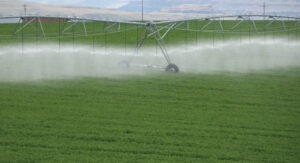
As you drive through our region you will see lots of irrigation, including the massive center pivot irrigation systems. Spraying fields and slowly crawling in a circle, these systems help the farmers reduce labor and be precise with their precious water. Studies show that with these systems, and certain crops, distributing the water closer to the ground saves water.
Depending on the crop, It could be a drip system sliding on the ground, or emitters right above the soil, or sprinklers 3 to 4 feet above the ground; all of which are still closer to the target than way up on the top of the boom.
These technologies improve the sprinkler system’s efficiency, reduce the evaporation from the sprinkler, reduce moisture loss from wet leaves, and increase consumption per acre. Although the technology is primarily used on pivots, it can also be used with other irrigation systems. WSU and University of Idaho found water savings of 5 to 15%. Additionally, this system may also reduce fertilizer requirements, and has the potential to improve crop quality and yield. It’s a win-win for everyone involved.
If you are an irrigator interested in making a change, you can go to our Rebate Offers page to see available rebates, and please feel free to call me.
Not an irrigator but you have a lawn? My dog and I love the green but wonder if my watering habits are correct.
Water costs money. Someone who does a good job of irrigation management will have a greener lawn, better landscaping, and a lower water bill than someone who doesn’t. Poor irrigation management also has an environmental impact because water is a limited resource. The more we use, the less water is available for alternate uses. Water is also the primary vehicle that moves fertilizers and pesticides off of landscapes and carries them into our streams and lakes where they can cause environmental damage.
Under-watering lawns leads to poor quality grass. Overwatering leads to high water bills, contributes to lawn disease, and leaches plant nutrients out of the soil and into the groundwater where they degrade water quality. Knowing how much, and when to water lawns can save water, save money, and improve the health and vigor of your lawn.
The Residential FAQ online at the WSU website has some great tips, and there is a Lawn Watering In Washington Guide (PDF).
Water is a precious commodity and doing our part to use it wisely helps us all.
If you have a question about energy efficiency, please email Charlie, or call (509) 526-4041.