Contact Us:


Story and photos by Rural Montana Editor Ryan Hall
The 4 lower Snake River dams may now be most known for their fish-mitigation measures and for producing clean, affordable, and reliable power. However, when they were built, the primary goal was much different.
“The main reason they were built was for navigation,” said Paul Ocker, chief of operations and maintenance for the Walla Walla District of the U.S. Army Corps of Engineers, which oversees the dams.
That function remains key today. The dams serve the most inland seaport in the Pacific Northwest, the Port of Lewiston in Idaho, allowing ocean access. Without the system of dams and locks, the river would not be navigable for barges and ships, according to shippers.
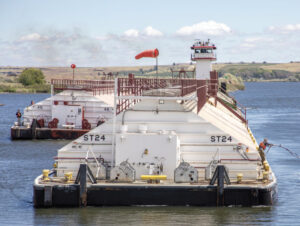
Ocker said the dams maintain a 14-foot deep navigation channel for the barges and ships that use the lower Snake River. Most lockages performed at the dams are for barges, though recreational lockages are also common. “We have a number of cruise lines that have discovered the Snake River,” Ocker said, noting an estimated 28,000 passengers cruise the river annually.
Most of the lock traffic each year is barges, with up to 4 large barges pushed up or down the river by a tugboat. Ocker said most of what is shipped on the river is wheat, with 10% of U.S. wheat traveling on the Snake River on its way to the Pacific Rim.
According to the U.S. Wheat Associates website, more than 55% of all U.S. wheat exports moved through the Columbia- Snake River System in marketing years 2019 to 2020 and 2020 to 2021.
“The Columbia-Snake River System is a superhighway of sorts for moving wheat and other agricultural products from farm to market,” U.S. Wheat Associates Market Analyst Michael Anderson said. “The ability to move such a large volume of grain efficiently makes the river system a very cost-effective and ‘green’ logistical option.”
1 barge can carry as many as 35 jumbo-hopper train grain cars or 134 semi-trucks. A 4-tow barge, the maximum size that fits in a lock on the lower Snake River, can replace 140 train cars or more than 538 semi-trucks. In addition, according to Anderson, 1 barge can move a ton of wheat 647 miles per gallon of fuel, while a semi-truck can only move a ton of wheat 145 miles per gallon.
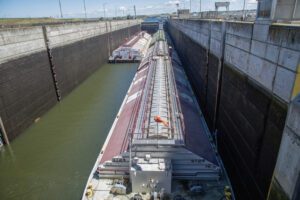
The locks along the Snake River are important because they allow boats and barges to safely navigate the approximately 400-foot change in water elevation from the first of the 4 dams to the last. Each lock is about 666 feet long, 86 feet wide, and holds about 43 million gallons of water.
A barge traveling downstream pulls into the lock, and then doors close behind it. Water is spilled out of the lock until the water level matches the downstream level, at which point the doors open, and the barge continues its journey. When traveling upstream, the process works in reverse, with water being let into the lock until the water level matches the level above the dam— approximately 100 feet. Once that occurs, the barge continues upstream.
Though the time varies by lock style, it typically takes less than 20 minutes for the whole process. At Lower Granite Lock and Dam, which has 2 hinge-style doors, it takes about 11 minutes to fill the lock to go upstream and a few minutes longer to drain it for a downstream journey.
“We are 1 of the fastest ones because we were the last 1 built,” Lower Granite Lock and Dam Lock Operator Neil Carlson said.
Ice Harbor Lock and Dam, with its guillotine-style 740-ton gate raised and lowered with a 40-horsepower motor, takes about 15 minutes to fill for an upstream journey.
“We do the most recreational boats (of the 4 lower Snake River dams),” said Harold Wentworth, chief of operations for Ice Harbor Lock and Dam.
The average for that lock is more than 3 boats a day annually, while Lower Granite Lock and Dam sees about 1.5 boats a day, on average, though both dams have higher boat traffic from spring through fall.
In addition to wheat and other grains, forestry products, fertilizer, and vehicle fuel are shipped via barges on the Snake and Columbia rivers.
“We truly have a global impact,” Ocker said.
Used with permission of Rural Montana magazine.